
Nephrology The gut-kidney axis: urea, toxins and microbial detox in kidney disease
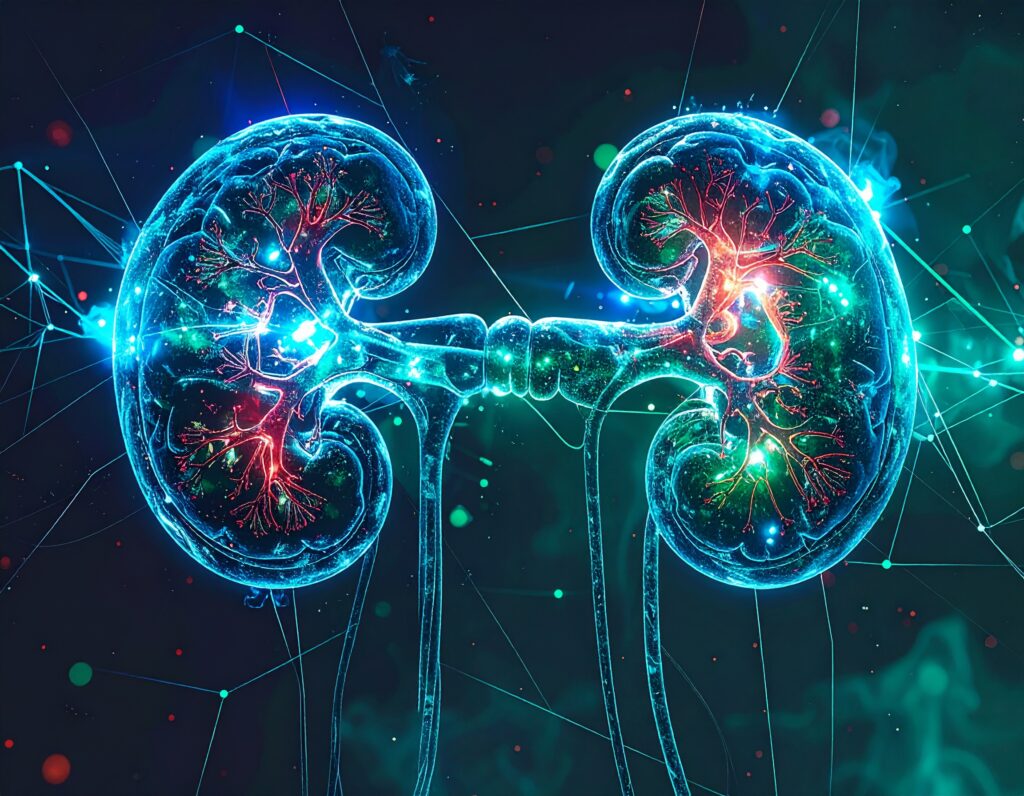
Chronic kidney disease (CKD) and acute kidney injury (AKI) have increased dramatically. Patients often struggle with fatigue, electrolyte disturbances, cardiovascular complications and increased mortality. But there is more: the kidneys are in constant dialogue with the intestines. The gut-kidney axis determines how urea, toxins and immune activation proceed.
Multi-omics makes this invisible communication visible and can help physicians better understand and preventively manage CKD and AKI.
The clinical problem
- In CKD, urea and toxins rise, leading to fatigue, vascular damage and immune dysfunction.
- Intestinal dysbiosis exacerbates this process by toxin-producing bacteria (e.g., indoxyl sulfate, p-cresol).
- In AKI, we see that intestinal barrier loss provokes systemic inflammation.(Ali et al., Int Urol Nephrol 2024).
- Patients with IgA nephropathy or lupus nephritis show specific intestinal renal crosstalk profiles.(Wang et al., Theranostics 2025).
Multi-omics insights into the gut-kidney axis
- Hyperuricemia & Akkermansia
- Fu et al., ASM 2025: showed that Akkermansia muciniphila (live or inactivated) lowers uric acid via intestinal renal crosstalk and can mitigate hyperuricemia. - IgA nephropathy
- Wang et al., 2025: multi-omics shows that specific microbial profiles co-drive IgA aggregation and renal inflammation. - Sepsis & organ crosstalk
- Borges et al, Ann Intens Care 2024: In sepsis, gut-kidney-lung crosstalk is disrupted, exacerbating systemic damage. - CKD progression
- Giordano, UU 2025: in vitro multi-omics platform reveals how microbiota-derived metabolites accelerate or inhibit CKD progression. - Inflammatory crosstalk
- Herranz, EMBO J 2025: described how gut-kidney interactions increase tumor mortality through NF-κB activation.
Innovative solutions for the clinic
- Renal Detox Index
- My InnerSelfie analyzes microbial toxins (indoxyl sulfate, p-cresol) and correlation with DNA variants in detox pathways. - Microbiome-Uremic Toxin Map
- Visualizes which bacteria amplify or buffer toxins. - Immune Crosstalk Scan
- Detects gut-driven inflammatory pathways that exacerbate CKD or AKI. - Therapy personalization
- Supports nephrologists in matching dialysis, nutrition and medication to the microbiome profile.
Why My InnerSelfie is unique
- Multi-omics integration: DNA, metabolites and microbiome in a single clinical profile.
- Crosstalk focus: we map the dialogue between gut and kidneys.
- Preventive precision: risks of progression of CKD or AKI become apparent early.
- Additional tool for the physician: decisions always remain in the hands of the nephrologist; we provide additional insights.
- Tomorrow's care: innovative, preventive and always customized. Innovation of today becomes the standard of tomorrow - safe and scientifically based.
Key insights
- Intestinal renal crosstalk plays a crucial role in CKD, AKI and IgA nephropathy.
- Dysbiosis amplifies toxin production and inflammation; multi-omics makes this visible.
- My InnerSelfie offers nephrologists new tools to monitor disease progression and personalize therapy.
Scientific references
- Fu Y, Chen J, Cao Q, et al. Gut-kidney axis modulation by Akkermansia muciniphila mitigates hyperuricemia. ASM J. 2025.
- Wang X, Zhou XJ, Qiao X, et al. Systemic mechanisms in IgA nephropathy: gut-kidney crosstalk. Theranostics. 2025.
- Borges A, Bento L. Organ crosstalk and dysfunction in sepsis. Ann Intens Care. 2024.
- Herranz H. Inflammatory crosstalk: gut-kidney interplay in tumor host mortality. EMBO J. 2025.
- Giordano L. Gut-kidney axis in CKD: in vitro insights into interorgan crosstalk. UU Research Portal. 2025.
- Ali A, Wu L, Ali SS. Gut microbiota and acute kidney injury: immunological crosstalk. Int Urol Nephrol. 2024.
