
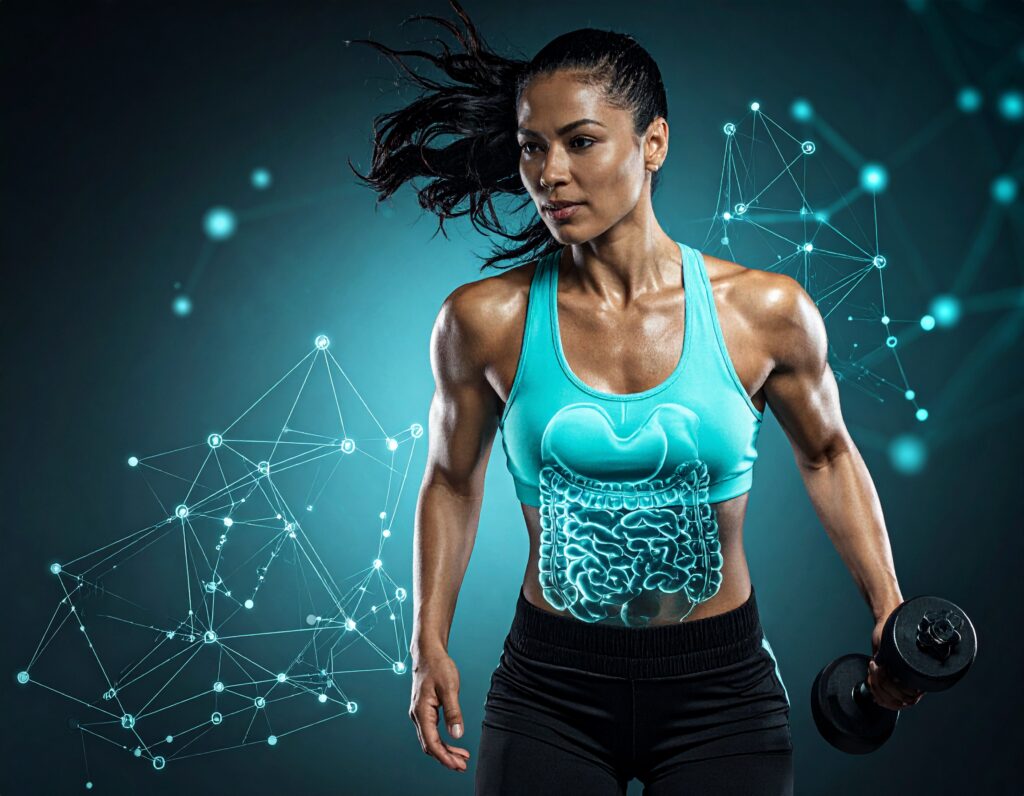
An Olympic peak is no accident. It is a finely tuned process of training, nutrition and recovery. But behind the muscles and lungs lies a second arena: your microbiome and metabolome co-adjust to the training load. Those who understand that can gain an extra few percent - and at the Olympic level, that's medals.
Training as an ecosystem reset
- BMC Microbiome (2023) showed that intensive exercise cycles change the microbiome not only in composition but also in functional capacity (energy production, stress resistance).
- With progressive loading, bacteria increase that recycle lactate and amino acids more efficiently.
- When overloaded without recovery, this flexibility decreases → metabolic "rigidity" and higher injury risk.
Crosstalk: muscles ↔ microbiome
New insights show that muscle tissue and microbiome communicate directly:
- Amino acid turnover: microbial breakdown of proteins affects muscle recovery as well as hypertrophy.
- Bile acid modulation: intense exercise alters bile acid profiles, which act back on mitochondria in muscle cells.
- Post-exercise metabolites such as indoles direct inflammatory sensitivity of muscle tissue.
Journal of Exercise & Organ Cross Talk (2024) described this as a "training imprint in the microbiome " - measurable with multi-omics.
DNA & adaptability
- ACTN3 and COL5A1 → muscle fiber type & connective tissue load.
- NRF2 variants → determine antioxidative capacity under high exercise stress.
- FUT2-secretor status → affects which bacteria produce training-related metabolites.
Thus, not all athletes derive the same "microbial gain" from identical training regimens.
Innovative biohacks heading toward Olympic peak
- Training-Response Index
- My InnerSelfie links DNA, microbiome and metabolites to predict whether an athlete is under-, optimal or over-adapting. - Cyclic microbial load
- Not linear loading, but periods when the microbiome is deliberately stimulated (e.g., via dietary fiber variation or timing of protein loading) to maintain flexibility. - Post-exercise metabolite monitoring
- Instead of just lactate → measure microbial indoles, SCFAs and oxidative markers to see if recovery is adaptive or destructive. - Precision tapering
- Multi-omics reveals who benefits from a long taper (recovery microbiome needed) and who peaks shorter (rapid adaptation). - Holobiont coaching
- Training not just for muscles, but for the entire ecosystem human + microbiome.
Why My InnerSelfie is unique
- DNA → reveals repair and adaptation genes.
- Microbiome → shows how training changes metabolites and gut diversity.
- Metabolites → measure real-time whether adaptation is favorable.
- Result → personalized training preparation that goes beyond generic schedules.
Key insights
- Training changes not only muscles, but also microbiome and metabolome.
- Crosstalk between muscle and gut bacteria determines adaptation and recovery.
- DNA and microbiome explain individual differences in training response.
- My InnerSelfie enables precision training toward Olympic peak.
Scientific references
- Mohr AE, Mach N, Pugh J, Grosicki GJ. Microbiome alterations and ecological resilience during training. FEMS Microbiol Rev. 2025.
- Nouri M, Arazi H. Crosstalk between gut microbiome, proteolysis and muscle hypertrophy. J Exerc & Organ Cross Talk. 2024.
- Clauss M, Gérard P, Mosca A, Leclerc M. Exercise and gut microbiome in performance. Front Nutr. 2021.
- BMC Microbiome. (2023). Training load shapes microbiome function beyond composition.
- Springer Sports Medicine. (2022). Genetics of training adaptation in elite athletes.
